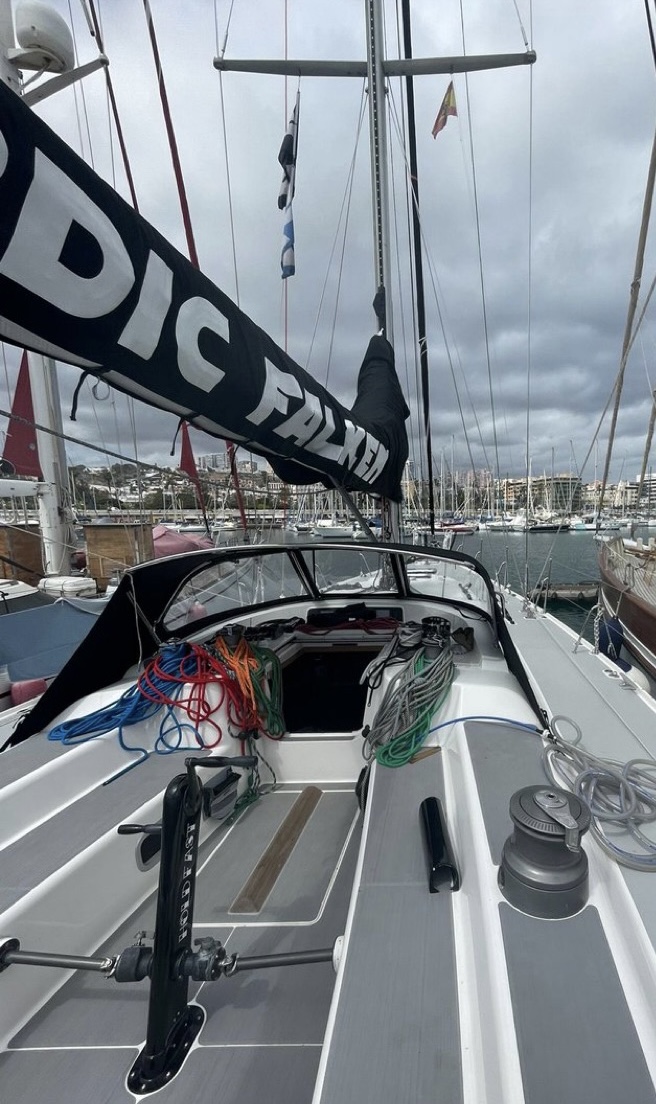
I’ve been on the water for a few months now. Firstly, on a delivery from the UK across the Bay of Biscay to Gijon and then from Marseille, through the straights of Gibraltar and up the coast to Porto (on the only Archambault A13 ever built). After a short flight from Porto to Gran Canaria, I was ready for my first transatlantic crossing. Stepping onto Falken, a Farr 65, I met up with 59 North’s Mia Karlsson and Skipper Chris Kobusch. I was introduced to 59 North by Nikki Henderson who is my mentor through the Magenta Project. I was paired with Nikki because of her experience as a Clipper Race Skipper, a goal that is firmly on my radar. I joined 59 North as an apprentice on the passage to Antigua. This was my first ocean crossing, so I was very excited and appreciative of the opportunity and was looking forward to leading one watch, while Mia the other.
During the start of the trip, the wind was light to moderate. The crew were lovely, and everyone seemed to enjoy themselves and settle into life at sea. One morning, after much anticipation, the crew hoisted the spinnaker for the first time. It was a fantastic sight to see people’s faces light up as the wind filled the spinnaker, a sight we anticipated seeing a lot of over the next few weeks (more to come on that later). We could’ve done with a bit more wind but there was enough to keep the spinnaker flying for the most part, and the sea was calm. We sailed South for a few days to avoid light wind but then headed West. It felt good to be heading towards Antigua rather than Antartica! I enjoyed settling into life downwind. It was amazing watching the crew develop, particularly helming Falken downwind with the spinnaker, needing less and less help every time. Nerves eased, everyone settled into the watch system and the crew quickly picked up the skills of trimming the kite.
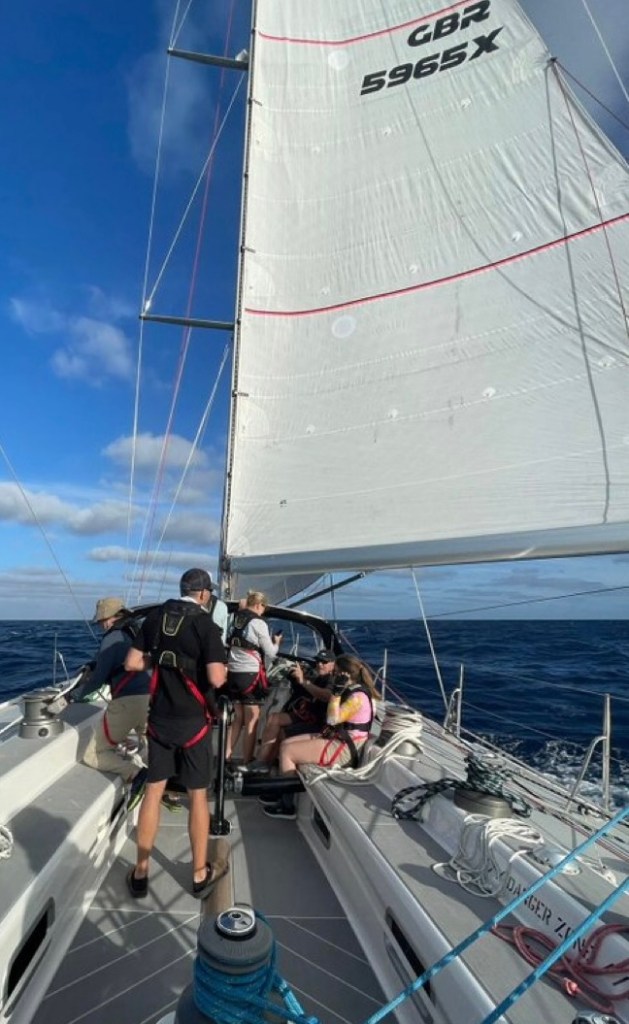
As we head further South the temperature noticeably increased and protective long-sleeved clothing appeared. During the few hottest hours of the day I occasionally noticed the helm creeping to windward to increase the apparent wind over the deck for some relief from the intense sun. It was hot on deck, under the sizzling sun, especially with no shade. The on-watch crew took turns to go down below and sit under the fans which seem to run on full power for most of the day. Shower day onboard was a source of mutual excitement amongst the crew as we prepared to wash the many layers of salt, sweat and sun cream off, ready to accumulate the same stickiness again until the next shower day. One shower day, the sunrise watch had a busy morning, hoisting the spinnaker only to notice the topping lift was being jammed into the mast by the main halyard so had to drop the main and re-hoist it when the lines were detangled; they really earned their shower that evening.
We all enjoyed the many pleasures of being at sea; being surrounded by the deep blue ocean and fluffy cumulus clouds in the day, dinner surrounded by dolphins and stargazing through the night. The wildlife was incredible, I’ve never seen so many playful dolphins, leaping out the water as the sun sets or in the moonlight – it’s amazing. We spotted lots of flying fish, a black tip shark and a whale; possibly a humpback whale but it was moving in the opposite direction, so it was difficult to tell. At night the sky was littered with stars and I ticked off more and more stars every night. I completed the Yachtmaster Ocean Theory course recently and was using astronavigation during the trip, thus sun and star sightings and calculations were a routine part of my passage.
Deck walks were completed every morning and evening to check for any chafing, loose bolts or shackles and anything that didn’t look quite right. After a day cruising along at around 7-8 knots under Yankee and full main, with one gybe in the afternoon as the wind veered further aft of the boat, the evening deck walk revealed significant chafing on the outhaul strop. So, the crew put a reef in to take the load off the outhaul and I put the climbing harness on, ready to cut off the old lashing and replace it. BANG! There goes the kite! The kite had torn around the tack and was flapping around behind the main. Fortunately, most of the crew were up on deck, energized from a mid-Atlantic stir fry cooked by Mia. Skipper Chris was already at the helm. After a few attempts, the foredeck crew got the spinnaker sock down and lowered the sail into the fore-hatch. That was the end of the spinnaker for the rest of our downwind sail to Antigua. Once the shredded spinnaker was squared away, we were sailing with just a Yankee and with an increased swell, and no spinnaker to power us through, we had to get used to moving around a surging boat. It also meant having to zig-zag to Antigua and stay further north than we anticipated resulting in a longer voyage.
Day 18 and we were less than 500NM out from Antigua, when the wind gods answered our prayers with the stable, consistent wind we had all been longing for. The wind picked up the previous night to around 20-25 knots resulting in our average boat speed increasing to 9-10 knots. We achieved our first day of 200NM, something we were all losing hope for despite seeming so possible on a Farr 65. Spirits onboard increased with the wind and for the most part, everyone had a smile back on their face. As we passed the 2-week mark, seeming to not make much progress, the days began to get longer and the 30-minute helming stints became more tedious.
As we creep towards Antigua, the temperature on deck has been increasing yet again. The crew do their best to hide in the little shade in the mid few hours of the day, but this makes for very pleasant afternoons in the shade of the sails, watching the sun set as we eat dinners and chat about the antics onboard. Discussions of priorities when arriving in Antigua have begun, for some it’s the first long land shower, for others it’s heading to the bar for an ice-cold drink. Although we are all pleased to be making good progress towards Antigua, it will be a shame to see this passage come to an end and I’m sure we will all be missing our floating island and peculiar 2am debates when back in the rain or sat in an office. As much as we may not appreciate it enough in the moment, it really doesn’t get much better than this!
Time (or perhaps duration) is a funny concept at sea, it becomes less and less relevant. Once in a routine the days and weeks all merge into one, we often struggled to remember how many days we’d been at sea and were amazed at how quickly time had flown. It was bittersweet losing the kite. But it also meant spending more time on our floating island, disconnected with the outside world. Imagine not showering for 10 days on land or cleaning your teeth at the most random of times, it would be frowned upon on land but it’s the norm at sea. When is morning, when is evening? When you’re at sea time simply becomes an authentic flow of experience, not a measurement of instants.


Leave a Reply