I grew up with two brothers, just one and two years older than me. There was no “girls vs boys” in our house, just competition. Backyard rugby started as a toddler, and from the very beginning, I was expected to hold my own. My dad used to call me Frank Bunce, the legendary New Zealand All Black known for the strength of his tackle. I was a sturdy toddler and completely disinhibited when taking my brothers down, and that carried on into my teenage years. I wasn’t the most agile player on the pitch, but if you were close enough when I tackled, there was often a collective groan of sympathetic pain from the sidelines.
I strongly resisted the term feminism. It conjured up images of people I didn’t identify with. This was despite my mum patiently explaining the different forms it could take. She rejected more radical interpretations, describing her perspective as intersectional, more grounded in equality. She also insisted my dad was a feminist. I remember looking sideways at him when she said that. He very sensibly never confirmed or denied it. But looking back, how could he not believe in equality for his wife, his daughter, and, maybe one day, his granddaughter?
There were no gender-stereotypical roles in our house. Both my parents worked. Dad did the school runs, the cooking, the shopping. Mum mowed the lawn. And there were many debates. My older brothers, particularly in their teenage years studying politics, philosophy and economics, would regularly bait my mum across the dinner table on feminism and plenty else. I absorbed those conversations reluctantly at the time, but they stayed with me.
For a long time my lived equality meant I thought the problem had already been solved. Then came sailing. Alongside the challenge and opportunity, there has been an undercurrent of everyday sexism, often not from a place of malice, but just as corrosive. During one of my Yachtmaster exams, the examiner looked at the two women on board and said, “I only need to take one look at you two to know you won’t be able to do that.” After returning from circumnavigating on the last edition, I was sailing into a Mediterranean marina on a yacht barely half the size of our race boat, when marina staff jumped straight on board and took over without asking. On an instructor’s course, another candidate repeatedly and “helpfully” took the sheets out of my hands whenever strength was involved. Before setting out as first mate on the Clipper Race, before having sailed with me, one of the crew said their worst fear was having a young female first mate. Individually, these moments are easy to dismiss. Together, they build a quiet but persistent question: are you being seen for your ability, or something else?
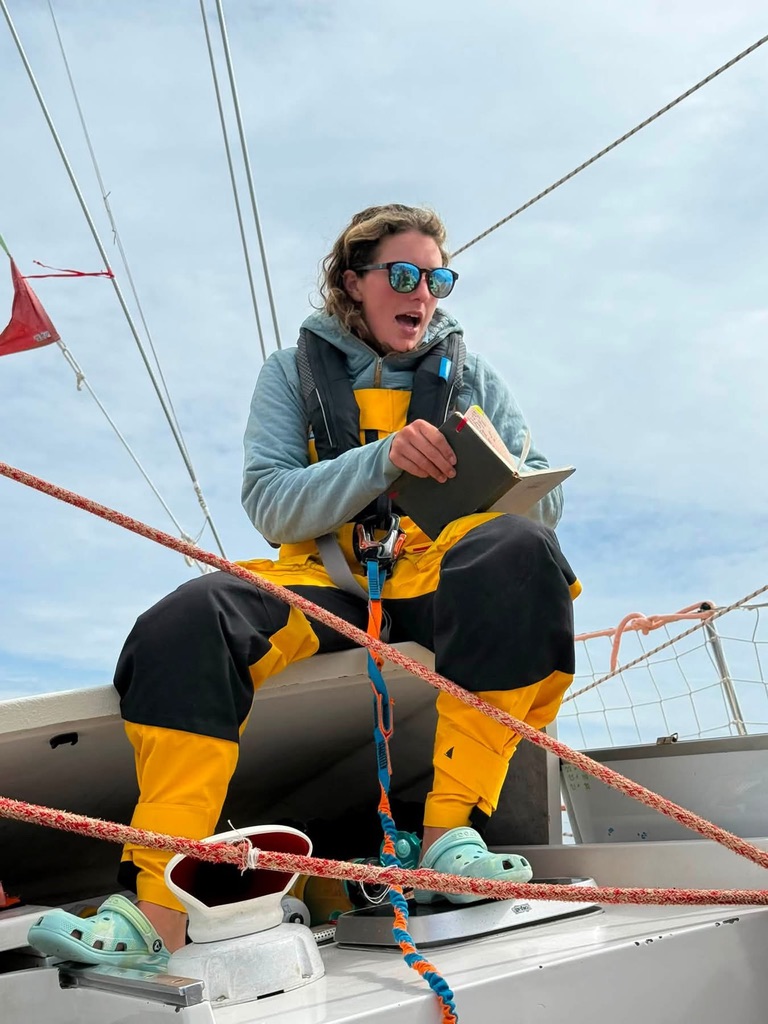
What holds me steady is the feedback from the people I actually sail with. As First Mate and now Skipper in the Clipper Race, many of the crew are middle-aged, often highly successful men. I have never experienced sexism from them. They judge me on my knowledge, my decisions, my leadership, and they are often generous in their appraisal. I’ve said before that I don’t confront every instance of sexism. If I did, I’d spend my days fighting and carrying a lot more anger than I want to. Instead, I’m anchored by something quieter: the knowledge that those who matter, know. But there are still moments that are harder to ignore.
In a difficult developmental conversation, a woman my own age said to me: “If you were a 45-year-old man, I would have behaved differently.” That stopped me. Not because it was unfamiliar, but because it was said so explicitly. And because it came from someone, I had felt a sense of shared identity with, a sense of solidarity. It was the clearest expression of sexism and ageism I had experienced.
I have quoted Simone de Beauvoir as her words hold so much meaning for me: “I hesitated a long time before writing a book on Woman. The subject is irritating, especially for women; and it’s not new. Enough ink has flowed over the quarrel about feminism… Let’s not talk about it anymore. Yet it is still being talked about.” Seventy-seven years on, it’s irritating that it still feels true. And that conversation with another young woman has weighed heavily on me, knowing that she represents another generation, whose biases and beliefs have real word impact, they act differently to young women. And the pain of that moment is not just for me, it is the very sad probability that if I one day have a daughter, and perhaps a granddaughter, there’s a real chance they will still have to talk about it too.
I’m still a reluctant feminist. But I’ve come to realise it’s not about the label; it’s about the reality that experiences like these still exist.


Leave a Reply