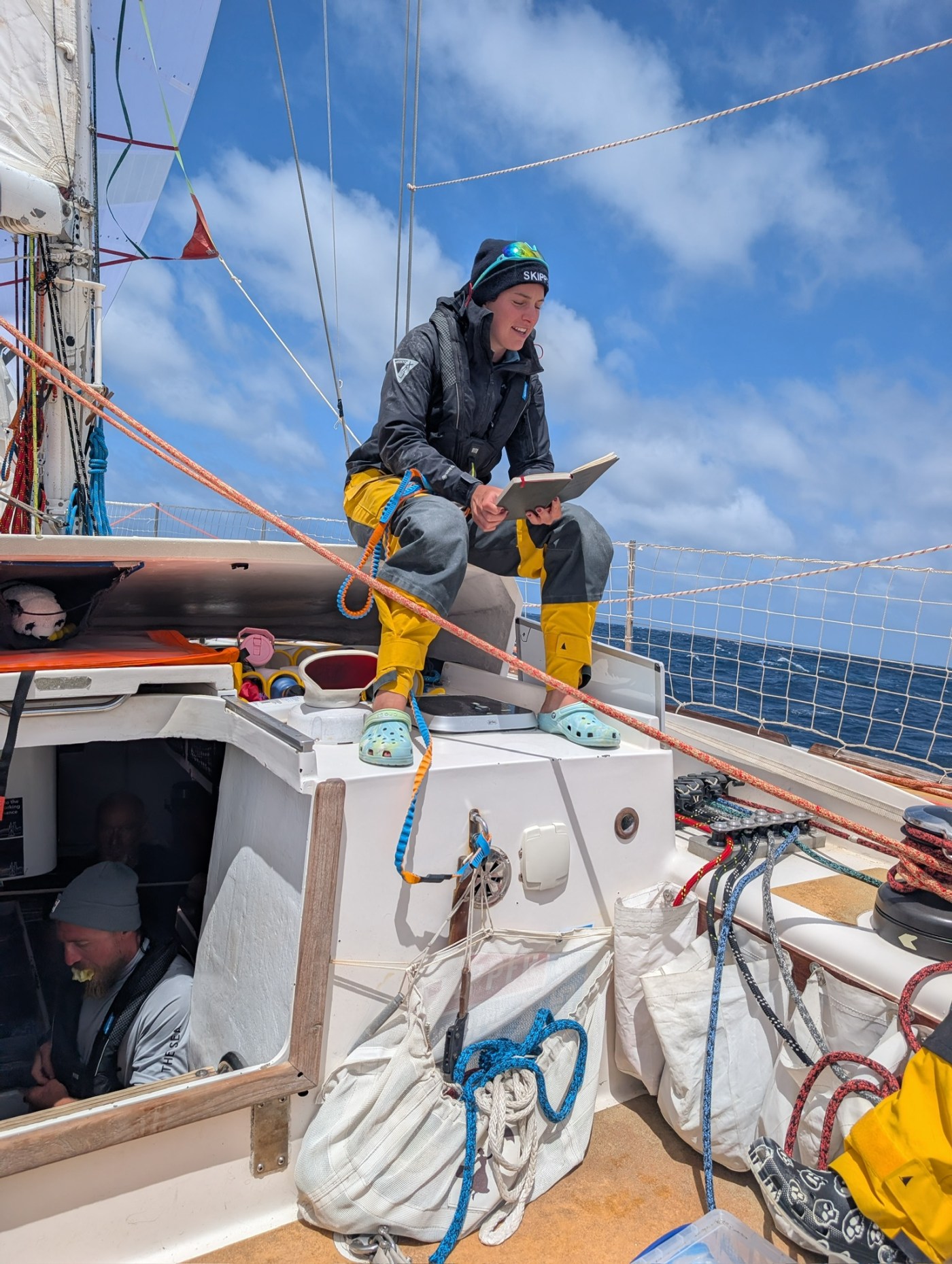
Rather than a sailing update, this post is something more personal; a moment to reflect on what it feels like to lead this race as a young woman, and the conversations that come with it. It’s also an acknowledgement of the family I won’t be with this Christmas.
During the last race, there was a lot of discourse around my age and my gender. It was noise I didn’t want to engage with too deeply at the time. I was focused on doing the job, and I wanted to shut out whatever might distract from that. So, when Sir Robin Knox Johnston, in conversation about our forthcoming podcast, said, “I’m not going to talk about your gender, as it’s not relevant; what’s relevant is what you are doing,” I felt quietly relieved.
And yet, during a recent stopover interview, I was asked: “As a woman, how are you able to lead and gain the trust of your crew?”
So, clearly, there is still work to be done.
Alongside this, there is also the undercurrent of everyday sexism, often not from a place of malice, but just as corrosive. During my Yachtmaster exams, the examiner looked at the two women on board and said, “I only need to take one look at you two to know you won’t be able to do that.” After returning from circumnavigating on the last edition, I was sailing into a Mediterranean marina on a yacht barely half the size of our race boat, when marina staff jumped straight on board and took over without asking. On an instructor’s course, another candidate repeatedly and “helpfully” took the sheets out of my hands whenever strength was involved.
And in every one of those moments, I said nothing.
My mum once asked me why I don’t challenge it. I told her, “Mum, if I reacted every time something like that happened, I would be angry every day. I don’t want to spend every day fighting. Those whose opinions matter already know.’
Simone de Beauvoir opens The Second Sex, first published in 1949 (more than 75 years ago!), with the words: “I hesitated a long time before writing a book on Woman. The subject is irritating, especially for women; and it’s not new. Enough ink has flowed over the quarrel about feminism… Let’s not talk about it anymore. Yet it is still being talked about.”
In sailing, many women have paved the way: Tracey Edwards, Ellen MacArthur, Dee Caffari, to name just a few. More recently, in the last Vendée Globe, 23-year-old solo sailor Violette Dorange publicly recognised that her campaign challenged perceptions of what young people, and young women, can do.
I’m not suggesting that feminist work isn’t still necessary. In many parts of the world, it absolutely is. But when gender intersects with age, both young and old, the effects are magnified. For me, it has been my age that has felt the loudest and most intrusive. In the past, I tried to distance myself from that narrative.
Now, stepping into the role of Skipper after being First Mate on the last race, it’s a conversation I can no longer sidestep.
The social discourse around age is powerful and pervasive. It shapes expectations before people ever meet you. And this is something that being a Hebron, being part of my family, has helped me make sense of.
The family I grew up in has profoundly shaped how I see the world. I see it through Hebron lenses. My brothers both studied Politics, Philosophy and Economics at university. My dad has an interest in politics and history. My mum is an academic whose work engages with philosophical and sociological concepts. Dinner table conversations were rarely light. They were often deep, sometimes heated, and never optional. I found them irritating at the time. I tried not to engage. I tried to tune out. But something must have stuck. My mum often says that social discourse around age isn’t necessarily “bad”, but it is dangerous. It does stuff.
I’m not even sure what generation I technically belong to. Not a Millennial, what comes after that? Generation XYZ? The problem with these labels is that they categorise people into populations rather than individuals. Generation Z is often described as fragile, anxious, entitled, resilient, depending on which headline you read. But there is enormous variation within any group. Discourses around mental health, resilience, and “snowflakes” are powerful. On the one hand, they have opened up vital conversations and reduced stigma. On the other, they can quietly lower expectations of what young people are capable of achieving.
There will be people who doubt that I can lead a diverse crew around the world. And yet, young people have led, and will continue to lead, in extreme, uncertain and high-stakes environments. My brother, just over a year older than me, was a young officer in the Royal Marines. His peers will lead in circumstances far more hostile than anything we’ll encounter in this race. Young people prove themselves every day.
I’m fortunate to have thoughtful discussion partners outside the race, and I check in with them often. I bring them situations and ask: “These are the perspectives I can see—what am I missing?” “These are the options I think I have—what haven’t I considered?” And sometimes: “This is my ‘shitty first draft’ of the story I’m telling myself—can you help me unpack it?” (thanks to Brené Brown for that language).
I recently came across a quote that really landed: “It’s not the years in your career that matter. It’s the career in those years.”
But even that isn’t quite enough. Educational theorist Graham Gibbs argues that we don’t just learn through experience, we learn through reflecting on experience. I’ve spent many hours reflecting on the last race, using those reflections to shape my leadership on this one. And, as I’ve written before, I’ve learned to cut out the noise.
The Clipper bubble is a noisy place. Much of it is good noise, banter, pressure, excitement, anticipation. But it also carries gossip and unhelpful speculation. With practice, I learned to distinguish useful feedback from background static. I learned to distance myself from the tinnitus. This race, I hope not just to sail well, but to quietly, consistently show what young people can do.
And that brings me back to family. Because it was family, through challenging conversations at the dinner table, that taught me to think, to reflect, and to remain steady when the world gets loud. And for that grounding, that ability to question the narratives around me rather than absorb them unquestioningly, I owe a great deal to my family.
I hope that, during this race, I don’t just prove something about my own leadership but quietly expand what people believe young women can be and do, without needing to fight every battle along the way. And I hope we can all judge others not by age, gender, the colour of their skin, or any other physical characteristic, but by their words and their actions, not just what they do, but how they do it.
Ella out


Leave a Reply