Team Washington DC supporters update 20th January
The stories we tell ourselves about luck on this race are curious ones. We often reach for luck as an explanation; sometimes fairly, sometimes as a convenient way to avoid confronting harder truths.
In reality luck’s influence varies.
There are events we frequently label as bad luck; sail tears, kite wraps, damage to the mast track, but most of these sit firmly in the realm of seamanship. They are the inevitable errors made on board when pushing a boat hard in demanding conditions.
Then there are wind holes, currents, and navigational decisions. These sit in a greyer space, shaped partly by skill and partly by fortune. On the last leg, for example, the main fleet were forecast to sail into a large and unavoidable wind hole south of Tasmania. It didn’t materialise … until days later as we were recovering from Steve’s medivac. By then, we had clawed back 150 nautical miles on the fleet, only to lose all of it again. Just our luck.
We were also acutely aware of the East Australian Current. We knew the dangers of sailing too close to the coast and being dragged the wrong way. There was a moment when we were sailing as far west as we dared, with the charts suggesting we’d be right on the edge of the current. In reality, the rotation at that point meant it was, luckily, working slightly in our favour. Regardless, we chose to move further east and away from the rhumb line. We didn’t want to push our luck. That was seamanship.
Medical evacuations are another grey area. Perhaps better sailors suffer fewer injuries, but our crew is not made up of professional athletes. Strength, balance, agility, and experience vary, as does the feasibility of evacuation. Earlier in this edition, one team incurred a time penalty when a medical evacuation inadvertently gave them an advantage over the fleet. Our luck looked very different. Our medivac meant sailing backwards for two days and losing over 400 nautical miles.
And then there are events we can fairly chalk up to luck; or the lack of it. Like hitting a whale. One could argue we’ve had more than our fair share of bad luck.
This race to the Philippines marks our first Le Mans start. There is a clear advantage to being the most windward boat; further down the line, you’re starting in increasingly dirty air and effectively further away from the racecourse. For that reason, starting positions are drawn from a hat. We drew the worst one. Just our luck.
But then comes perspective.
At the start of this campaign, I created a Padlet by sharing a video of myself during the last edition, spreading my grandad’s ashes south of Tasmania at the most southerly point of the race. He was pivotal in my becoming a sailor. He was my why. I asked the crew to share theirs.
Some were courageous enough to be deeply vulnerable. They shared stories of significant, traumatic, multiple, and unquestionably unlucky events that had shaped their lives and led them to sign up for this race. I remember reading some of them and thinking: how can one person have so much bad luck?
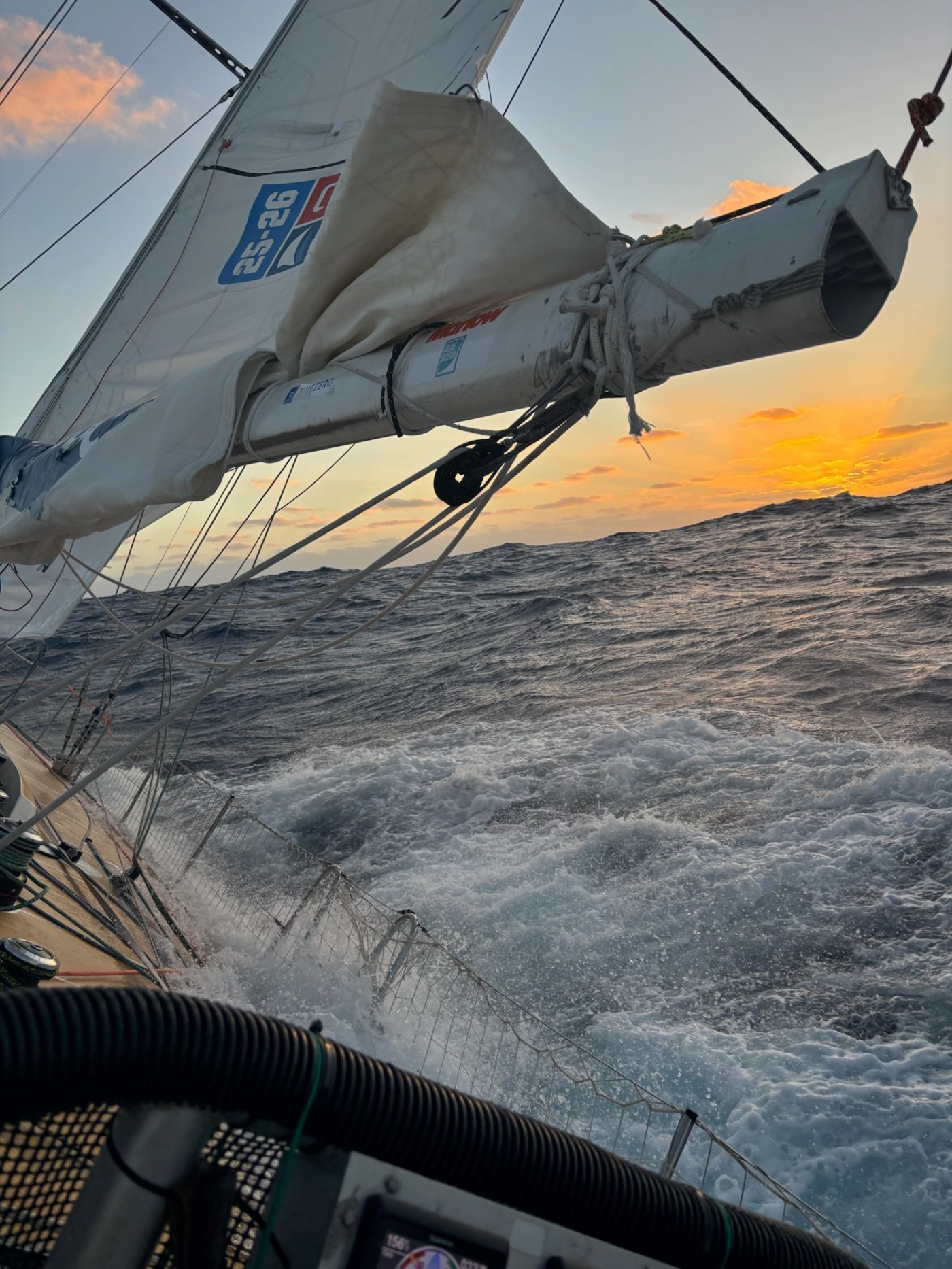
Out here at sea, we witness the most extraordinary beauty. Sunsets that stop you in your tracks. Stars brighter than you ever imagined possible. Albatross soaring effortlessly alongside us. Dolphins dancing at the bow. The sea glowing with phosphorescence at night. We’ve sailed into Cape Town with Table Mountain standing proud above us. Just days ago, we were drinking champagne overlooking Whitehaven Beach in the Whitsundays and snorkelling among a kaleidoscope of tropical fish.
How lucky are we?!
Before race start, I listened to a radio interview with Olympic gold medallist Sir Chris Hoy. He was asked how he copes with his terminal cancer diagnosis while having a young family. He spoke about a strategy he learned from his sports psychologist: taking a helicopter perspective. Sitting on the start line of a race he had trained four years for, he would imagine hovering above the track. Then he’d zoom out to gain a sense of perspective. I imagine him seeing the other athletes, the country he was competing in, the wider challenges faced by those living there. Perhaps he zoomed further still, above the Earth itself, recognising how small we all really are.
I know this starting position will be hard for the crew to swallow. Our luck so far makes that understandable. But a few days ago, some of them were literally in a helicopter, hovering above the Great Barrier Reef.
So, as we line up on the start line, we would do well to cut out the noisy thoughts about bad luck and starting positions. To zoom out, gain perspective, and remember just how fortunate we are to be here at all. Then, having done that, to zoom back in again and focus on the race in front of us.
There are many miles still to come. Miles full of decisions, teamwork, judgement, and resilience. And in those miles, through good seamanship, clear thinking, and the energy we choose to bring to the boat, we have plenty of opportunity to create a little “luck” of our own.


Leave a Reply